
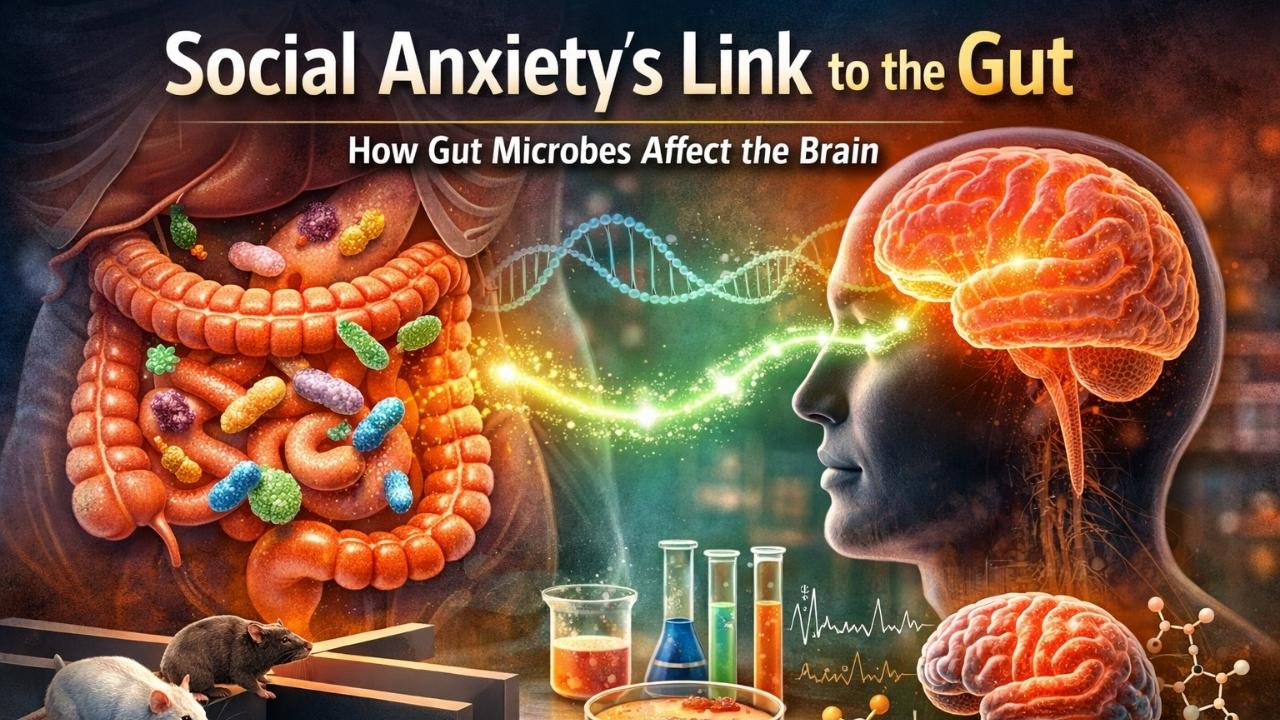
Social anxiety disorder commonly emerges during adolescence, a developmental window marked by rapid brain maturation and heightened social sensitivity. Population-based estimates indicate that between 7% and 13% of individuals experience social anxiety symptoms at some point, with many cases beginning before adulthood. Early onset is associated with higher risks of persistence into later life, academic disruption, and social withdrawal.
Although psychological therapies and medications are widely used, treatment outcomes vary. Clinical follow-up data show that a substantial proportion of adolescents experience partial response or relapse, suggesting that current approaches do not fully address the underlying biology of the condition. This has encouraged researchers to investigate physiological systems outside the brain that may influence emotional regulation.
A recent experimental study published in the Journal of Affective Disorders provides evidence that the gut microbiome may contribute directly to social anxiety-related behaviors. By transferring gut bacteria from adolescents with social anxiety into newborn rats, researchers observed behavioral and neurochemical changes consistent with anxiety, indicating a functional role of gut microbes during development.
Table of Contents
Social Anxiety Viewed Through a Broader Biological Lens
Social anxiety disorder is characterized by persistent fear of social interaction and negative evaluation. Neuroimaging research has consistently implicated the medial prefrontal cortex, amygdala, and related networks responsible for emotional control and social cognition. These findings support a neurobiological basis but do not fully explain why symptoms often emerge during adolescence or why treatment response differs markedly among patients.
Genetic studies estimate moderate heritability, leaving a large proportion of risk attributable to environmental and biological modifiers. Increasing attention has therefore turned toward systems capable of interacting with the developing brain, particularly those involved in metabolism, immune regulation, and stress signaling.
Among these systems, the gastrointestinal tract stands out due to its dense neural innervation, immune activity, and microbial population. The gut microbiome, comprising trillions of microorganisms, has become a central focus of research on whole-body contributions to mental health.
Can losing social status change your gut — and your mind?
New research says yes.A study found that social defeat rewires gut bacteria and brain chemistry in real time.
Let’s explore how status loss might trigger anxiety and depression—microbiome first 👇 pic.twitter.com/ppU5N5LWkf
— C. Vivek Lal (@CVivekLaL) May 4, 2025
The Gut–Brain Axis as a Regulatory System
The gut–brain axis refers to bidirectional communication between the gastrointestinal tract and the central nervous system. This communication occurs via neural pathways, endocrine signaling, immune mediators, and microbial metabolites that enter the circulation.
Gut bacteria influence neurotransmitter precursors, short-chain fatty acids, bile acids, and amino acid metabolism. Disruptions in these processes have been associated with altered stress responses and emotional behavior. Prior research has linked microbiome differences to depression, autism spectrum disorder, and stress-related conditions, but evidence specific to social anxiety had mainly remained correlational.
The study addressed this gap by experimentally testing whether anxiety-associated gut microbes could shape behavior and brain chemistry when introduced during early development.
Study Design Focused on Causal Testing
Researchers recruited 40 adolescents experiencing their first episode of social anxiety disorder and 32 healthy adolescents matched for age and sex. Strict inclusion criteria ensured that participants had no psychiatric comorbidities, no prior exposure to psychotropic medication, and no recent antibiotic use, thereby minimizing potential confounding of the gut microbiota.
Fecal samples were collected and subjected to genetic analysis to characterize microbial composition. Instead of examining associations alone, the researchers pooled samples from each group and transplanted the microbiota into newborn rats starting on the first day of life. Transplantation was performed daily until the rats reached adolescence.
This approach differed from many earlier studies that relied on antibiotic-treated adult animals. By colonizing newborn rats, the researchers aimed to replicate natural microbial development and avoid behavioral effects introduced by antibiotic exposure.
Behavioral Outcomes Observed in Adolescence
When the rats reached adolescence, they underwent standardized behavioral assessments commonly used to evaluate anxiety and social behavior. Rats colonized with microbiota from socially anxious adolescents displayed consistent anxiety-like patterns across multiple tests.
They spent less time exploring exposed areas and showed reduced preference for interacting with unfamiliar peers. Importantly, overall locomotor activity was similar between groups, indicating that the observed differences reflected emotional and social processing rather than physical impairment.
Behavioral Effects Observed in Rats Following Microbiota Transplantation
| Behavioral Assessment | Outcome in Anxiety-Microbiota Group |
|---|---|
| Open field exploration | Reduced time in center zones |
| Elevated maze testing | Increased avoidance of open arms |
| Social interaction task | Lower preference for social novelty |
Microbial Differences Identified in Adolescents
Analysis of human fecal samples revealed that overall microbial diversity did not differ significantly between adolescents with social anxiety and healthy controls. However, specific bacterial genera showed notable differences in abundance.
Adolescents with social anxiety exhibited higher levels of Prevotella and lower levels of Parasutterella. These genera are involved in metabolic pathways related to bile acid regulation, lipid metabolism, and nutrient processing. Although these changes were subtle, their functional relevance became evident through the transplantation experiments.
This finding suggests that qualitative shifts in microbial composition, rather than large-scale loss of diversity, may influence brain-related outcomes.
Brain Metabolic Changes Linked to Gut Microbes
Following behavioral testing, researchers examined the medial prefrontal cortex of the rats, a region central to emotional regulation and social decision-making. Metabolomic analysis revealed distinct biochemical changes in rats receiving anxiety-associated microbiota.
Altered amino acid levels, including threonine and aspartic acid, were observed, along with reduced beta-carotene. These compounds play roles in neural signaling, oxidative balance, and cellular metabolism. Changes in cholesterol and bile acid-related metabolites were also detected, aligning with reduced Parasutterella levels in the gut.
Gut and Brain Differences Associated With Social Anxiety Microbiota
| Domain | Observed Change |
|---|---|
| Gut microbiota | Increased Prevotella, decreased Parasutterella |
| Brain metabolites | Altered amino acids, reduced beta-carotene |
| Metabolic pathways | Disrupted bile acid and cholesterol regulation |
Proposed Biological Pathway Connecting Gut and Behavior
Based on combined behavioral and metabolic findings, the researchers propose a multi-stage pathway through which gut microbes influence social anxiety-related outcomes:
- Altered gut microbiota composition during adolescence
- Disruption of metabolic signaling involving bile acids and amino acids
- Biochemical changes within the medial prefrontal cortex
- Emergence of anxiety-related and altered social behaviors
This sequence provides experimental support for a functional gut–brain mechanism rather than a secondary association.
Study Scope and Limitations
While the findings offer strong experimental evidence, several limitations affect interpretation:
- The human cohort consisted solely of Han Chinese adolescents, limiting population generalizability
- Specific bacterial strains and metabolites responsible for the effects were not isolated
- Immune system markers and stress hormone pathways were not directly measured
These constraints indicate that further research is needed to clarify precise mechanisms and broader applicability.

Implications for Future Research
The study expands the biological framework for understanding social anxiety by demonstrating that gut microbiota can influence behavior and brain metabolism during adolescence. Future investigations are expected to identify specific microbial strains, map immune and stress-related signaling pathways, and test whether similar mechanisms operate across different populations and age groups.
At present, the findings do not translate directly into clinical interventions. However, they provide a data-driven foundation for exploring gut-focused approaches as part of a broader understanding of social anxiety disorder.