
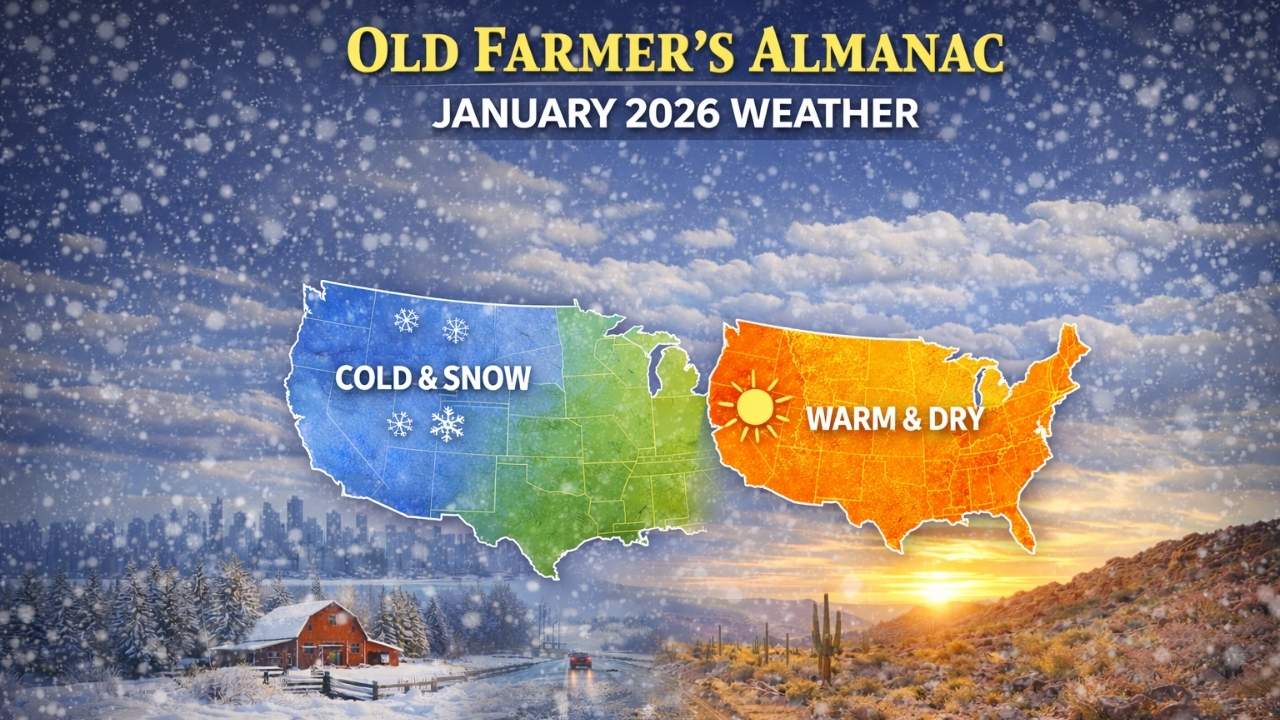
The Old Farmer’s Almanac has published its long-range weather forecast for January 2026, offering an early look at how winter’s coldest month may shape conditions across the United States. The outlook highlights regional temperature trends, snowfall expectations, and periods of rain or sunshine rather than short-term daily forecasts.
The historical publication predicts that January will start with widespread cold across much of the country, especially in the East and Midwest. While several regions forecast brief warm spells, many areas are likely to experience colder-than-average conditions overall, with precipitation patterns sharply varying by location.

This forecast provides a broad framework for understanding how winter may peak across the U.S., helping households, businesses, and travelers prepare for potential cold snaps, snow events, and shifting weather conditions.
Table of Contents
Eastern States Likely to See Early Winter Intensity
In the Northeast, January is expected to bring strong winter conditions. Northern states such as Maine, Vermont, and New Hampshire are expected to experience frequent snow early in the month, while areas farther south may see lighter flurries mixed with dry but cold air. Temperatures during the opening weeks are forecast to remain consistently below seasonal averages.
As the month progresses, the Almanac indicates a short window of milder weather. Increased sunshine and slightly warmer daytime highs could temporarily reduce snowfall, particularly in the southern parts of the region. However, this break is expected to be brief.

By late January, colder air is forecast to return, bringing a mix of flurries, rain, and colder nights before the month ends on a clearer but chilly note. Overall, the Northeast is expected to finish January slightly colder and drier than normal.
You may have heard “The Farmers’ Almanac” has ended after 200 years. These are products from 2 different companies. The Old Farmer’s Almanac will still be produced. pic.twitter.com/flUWX5CPdt
— Shawn Hendrix (@TheShawnHendrix) November 7, 2025
Atlantic Corridor Forecast Points to Dry Cold Spells

Along the Atlantic Corridor, January is expected to open with sharply cold conditions. Northern portions of this region may experience scattered flurries, while southern areas remain dry but unseasonably cold. Wind chill and overnight lows may be particularly noticeable during this early stretch.
A brief period of snow is expected during the second week of January, after which the region may settle into a longer stretch of mostly sunny and dry weather. Temperatures are forecast to rise gradually over this period, but are still expected to remain below average.
Toward the end of the month, rain and slightly milder air could make a short return before colder conditions move back in. The Almanac’s overall signal indicates that January will be drier than usual across the Atlantic Corridor.
Appalachians and Southeast Show Mixed Winter Signals
The Appalachian region is forecast to experience a January shaped by elevation differences. Early in the month, colder air is expected across the region, with flurries more common in northern and higher-elevation areas. Lower elevations may remain dry but cold.
Mid-month conditions are expected to soften, bringing a mix of snow and rain depending on location. These shifts may lead to uneven snow coverage, particularly in mountainous areas where temperature changes can be more pronounced.
In the Southeast, including the Carolinas and Georgia, January is forecast to begin with unusually cold but sunny conditions. Rain and milder air are expected to follow mid-month, before colder temperatures return later. Overall, the Southeast is projected to experience a slightly cooler and drier-than-average January.
Florida Expects to Stay Cooler Through Much of January
Florida’s January outlook suggests temperatures will run below normal for much of the month. Early January is forecast to be mostly sunny, though isolated showers may occur.
Rainfall is expected to become more frequent as mid-month approaches, particularly across central and southern parts of the state. Despite these showers, extended warm periods are not expected.
The Almanac projects that while rain may increase late in the month, overall January precipitation will still be slightly below average, reinforcing a cooler and relatively dry winter pattern for Florida.
Midwest and Ohio Valley Brace for Sustained Cold
Across the Lower Lakes region, January is forecast to deliver classic winter conditions. Cold temperatures and snow are expected early in the month, with lake-effect snowfall likely in areas downwind of the Great Lakes.
A modest warming trend may develop mid-month, especially in western areas where sunshine is forecast to increase. Eastern sections are more likely to continue seeing flurries and colder conditions.
The Ohio Valley is expected to follow a similar path, with early cold and snow giving way to a brief mid-month warm-up before colder air and mixed precipitation return late in January. Both regions are expected to end the month colder and drier than average.
Plains and south-central states See Strong Regional Contrasts
In the Heartland, January is forecast to start cold, then transition to sunnier but still chilly conditions. Mid-month warming may bring rain or snow showers in southern areas, while northern sections remain colder.
Texas and Oklahoma are expected to experience a cooler-than-average January overall. Northern areas may stay relatively dry and sunny, while southern sections see more frequent rainfall, especially later in the month.
The Almanac suggests that the Heartland could finish January slightly warmer than average, while parts of southern Texas may trend wetter than normal.
Upper Midwest, High Plains, and Western Outlook
The Upper Midwest is forecast to face some of the most severe winter conditions in January 2026. Bitter cold is expected early and late in the month, with only brief mild intervals in between. A late-month snowstorm is also anticipated.
The High Plains, by contrast, are forecast to begin January with unusually warm conditions, particularly in northern areas. While isolated rain or snow showers may occur mid-month, temperatures are expected to remain above average before cooling late.
In the West, the Desert Southwest is expected to see early warmth and rain, followed by colder conditions mid-month. The Pacific Northwest may alternate between chilly sunshine and wetter periods, while the Pacific Southwest is forecast to be slightly warmer than average overall.
Frequently Asked Questions
1. How does the Old Farmer’s Almanac create its weather forecasts?
The Almanac uses a proprietary formula that blends historical climate data, solar activity, and long-term weather patterns to identify broad trends.
2. Is January 2026 expected to be colder than usual?
Many eastern and northern regions are forecast to experience colder-than-average conditions, while parts of the Plains and West may see warmer trends.
3. Which areas may experience the most snowfall?
Northern regions such as the Northeast, Upper Midwest, and Great Lakes are expected to see the most consistent snowfall during January.
4. Will January be a wet month across the U.S.?
Several eastern regions are forecast to be drier than average, though parts of the South and West may experience periods of increased rainfall.
5. How accurate are long-range forecasts?
Long-range forecasts are most reliable for identifying general trends rather than predicting specific weather events or exact timing.